CAMEA Digital WIM Sensor with Novel Features
The WIMTRONIC digital sensor has embedded electronics, multiple rows of sensing elements and additional on-board sensing technologies will not only save costs on components and cabling but also provide new functions which can significantly improve the overall performance of WIM applications.
Precision Engineering and Longitudinal Sensitivity
It uses individually pre-loaded piezoelectric elements, so the sensitivity is not affected by manufacturing tolerances of the sensor’s components and the body. The longitudinal sensitivity and calibration constants can be calculated for each sensing element individually to ensure uniform longitudinal sensitivity.
Dynamic Force Monitoring
- WIMTRONIC PROVIDES NEW FUNCTIONALITIES INCLUDING TIRE PRESSURE MEASUREMENT, DETECTION OF VEHICLE DIRECTION, AND ROAD-PAVEMENT DEFLECTION
Using two or more rows of load cells enables monitoring of dynamic forces caused by the tires. That Based on the response of each row, vehicle acceleration and braking can be determined as well as the position, travel direction, wheel track, dual tires, speed of each wheel, and others. This information can be further used to determine which measurements should be considered valid.
Tire Footprint Analysis
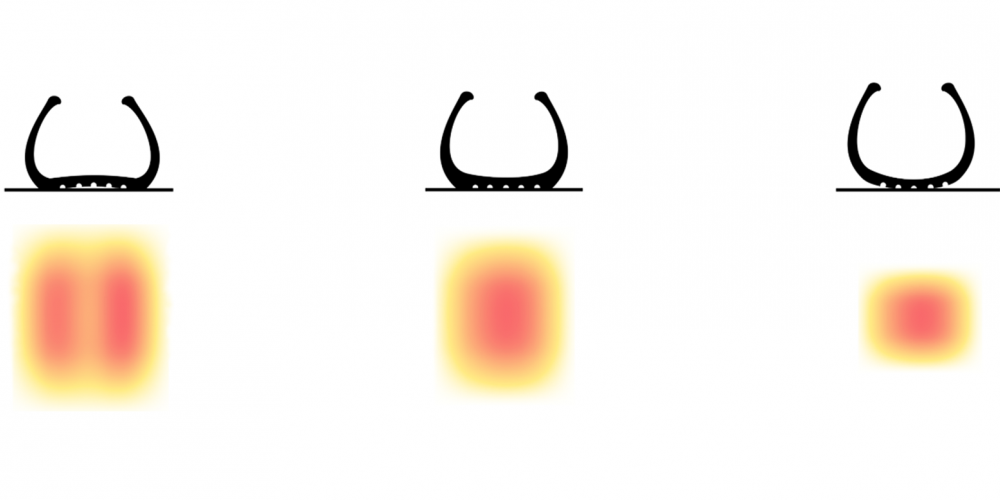
Thanks to individual measurement of the responses of each load cell, the digital sensor enables to measure the road deflection, the tire pressure and the shape and surface of its footprint. The figure shows the measured pressure distribution in the tire footprint in the cases of underinflated, correctly inflated, and overinflated tires.
- TIRE PRESSURE MEASUREMENT USING THE NEW CAMEA WIMTRONIC DIGITAL SENSOR
Our novel digital WIM sensor detects dual tires, measures wheel position, width, and tire inflation pressure.
In order to verify the limits of accuracy that can be achieved, we used a light two-axle truck with narrow tires (195/70 R15), which has small footprint and therefore the largest error in measuring its area. The tests were performed in a controlled manner so that uneven driving of the vehicle could not affect the accuracy of the measurements. Tire pressure measurement with an error within 21±13 kPa (4.8±3.0 %) was achieved.
Also, as shown in the left chart shows, the cumulative road load (in kilotons) caused by the vehicle's wheel measured using a 2m sensor, we can see that the maximum load is roughly in the center of the sensor. This is the point through which most vehicle wheels pass - the driving track in which rutting appears. The right chart shows the measured cumulative pressures (in GPa) exerted by the vehicle tires on the road surface.
As the results clearly show, WIMTRONIC can measure tire pressure accurately. In combination with precise lateral position, it can measure the cumulative counts, loads and pressures in the transverse profile of the road. Therefore, the data provided allows a more refined assessment of road wear beyond the estimation of ESALs. This opens up new possibilities for load analysis of roads and infrastructure, and for planning their reconstruction, expansion, and maintenance.