Minimizing Impact of WIM Sensors on Road Integrity
Developers of WIM sensors face many challenges. The sensor’s design should naturally follow the primary purpose of WIM systems – road protection. As any cut in the road is a potential source of future damage, these should be minimized, both in number and in depth.
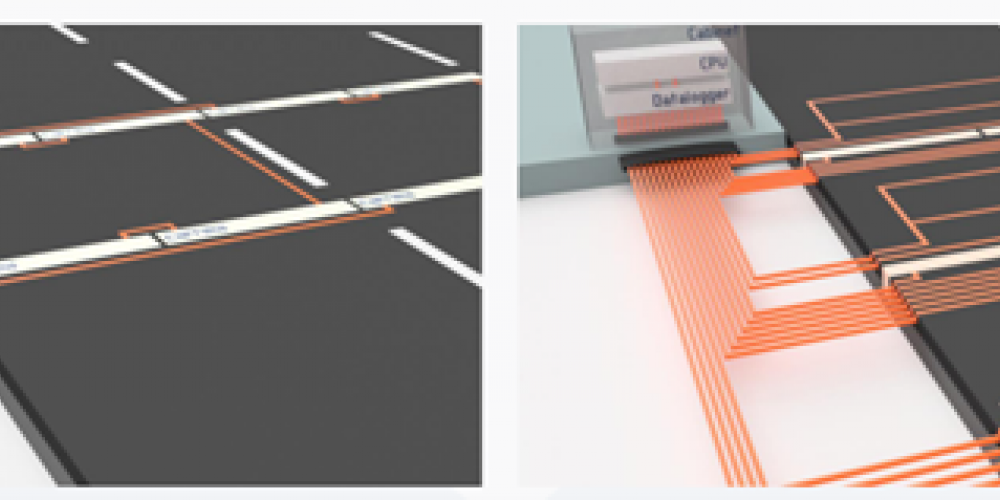
Maximizing Cabling Efficiency
Cabling is a major source of cuts in the pavement. Traditionally, all the sensing technologies built in the road at the WIM site need a cable to connect with the cabinet. That includes weighing sensors, inductive loops, position sensors, and temperature sensors. To reduce the number of cuts, all the named parts can be embedded in only one component – the weighing sensor, saving up to more than 10 cables per road lane, as well as valuable time, and significant amounts of money as a consequence of both.
The cable efficiency can go even further. Commonly, each sensor is wired separately. A ring daisy-chain interconnection is a more elegant solution that results in up to 4 times fewer cables used.
The Importance of Installation Depth
Furthermore, the road wear is accelerated with the depth of the installation. That is why it ideally should not reach other than the surface layer of the road. The thinner the sensor and the thicker the layer of high-quality pavement beneath it, the less vulnerable the road is to damage.
Recently, we have introduced a digital WIM sensor WIMTRONIC that was developed with respect to knowledge shortly presented above. Its low 45mm body (including a high 12mm abrasive layer) features embedded sensing technologies and digital processing of measured data, and multiple sensors can be interconnected in a ring daisy chain.